The work
Records need to be normalised, checked against several business-rule categories, investigated where needed, and reviewed before any finding can be shared.
The friction
The repetitive work is preparing records, checking several rule categories, merging findings, determining confidence, deciding which cases deserve deeper investigation, and organising findings for human review.
The system
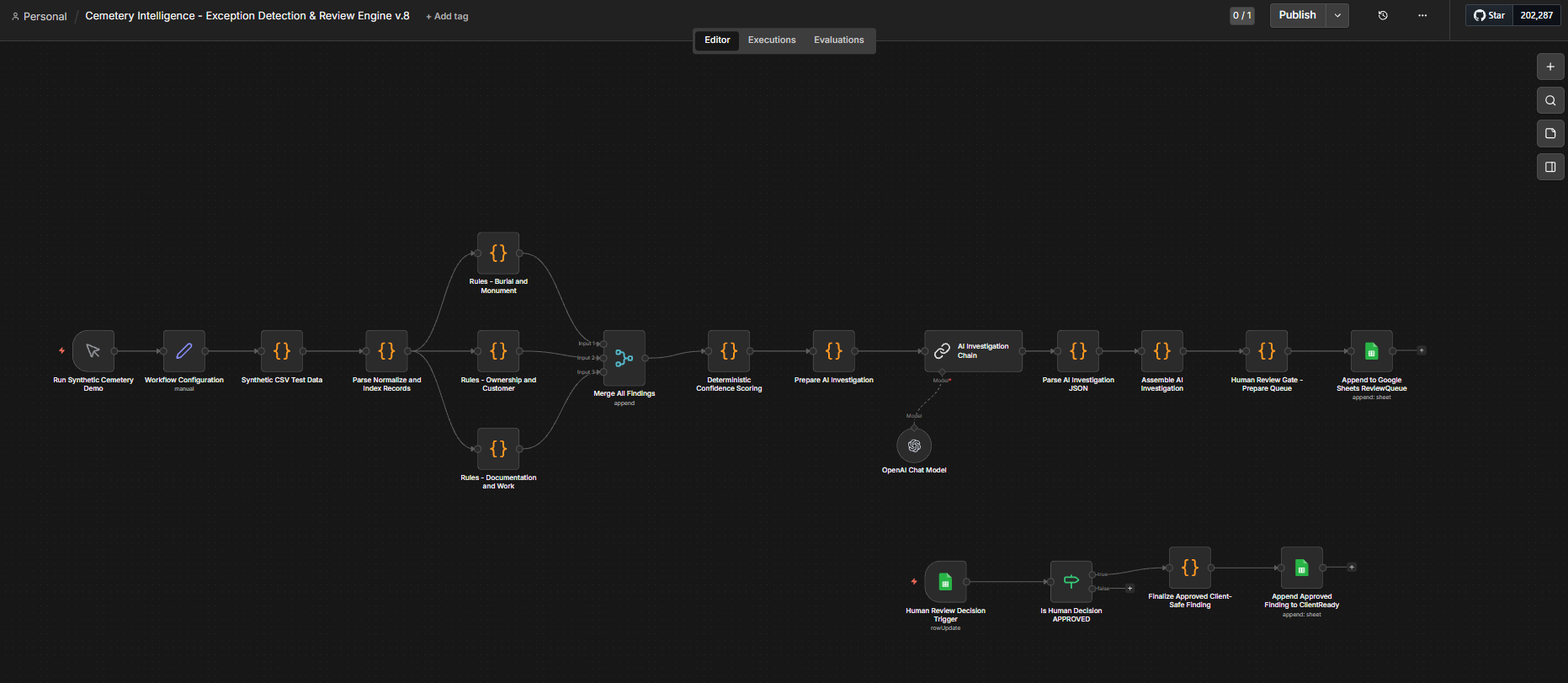
Deterministic rules run first and in parallel. AI investigates only what the rules leave uncertain, and the run stops at a review queue.
- Run Synthetic Cemetery Demo
- Workflow Configuration
- Synthetic CSV Test Data
- Parse, Normalize and Index Records
Deterministic rule paths, run in parallel
- Rules: Burial and Monument
- Rules: Ownership and Customer
- Rules: Documentation and Work
- Merge All Findings
- Deterministic Confidence Scoring
- Prepare AI Investigation
- AI Investigation Chain, using an OpenAI chat model
- Parse AI Investigation JSON
- Assemble AI Investigation
- Human Review Gate, Prepare Queue
- Append to Google Sheets Review Queue
Human decision flow, a separate run
- Human Review Decision Trigger
- Is Human Decision Approved?
Only the approved path continues
- Approved: Finalize Approved Client-Safe Finding
- Approved: Append Approved Finding to Client-Ready Google Sheet
What it handles
- Synthetic and test record ingestion
- Normalisation
- Indexing
- Deterministic rule evaluation
- Multi-rule finding aggregation
- Confidence scoring
- AI investigation preparation
- AI-assisted investigation
- Structured JSON parsing
- Review-queue preparation
- Google Sheets review queue
- Post-approval finalisation
What stays human
Human review is mandatory. A finding sits in the review queue until someone approves it, and only approved findings continue to the client-ready output.
- Approving or rejecting each finding
- Judging whether the evidence is sufficient
- Deciding what is safe to put in front of a client
- Everything downstream of the review gate
The principle
Automation prepares the decision. A person still makes it.
Exceptions
This system is built around exceptions. Surfacing them is the point of the workflow, not a side effect.
- Incomplete records
- Conflicting records
- Inconsistent findings
- Low confidence
- Disagreement between deterministic rules
- Uncertain AI findings
- Cases that should not proceed automatically
How it improves the workflow
The workflow separates repetitive record analysis from the judgment required to approve a client-facing finding. Rules and AI prepare the evidence, and the review gate stays in place.